
Oct 17, 2026 · @yitz waxman
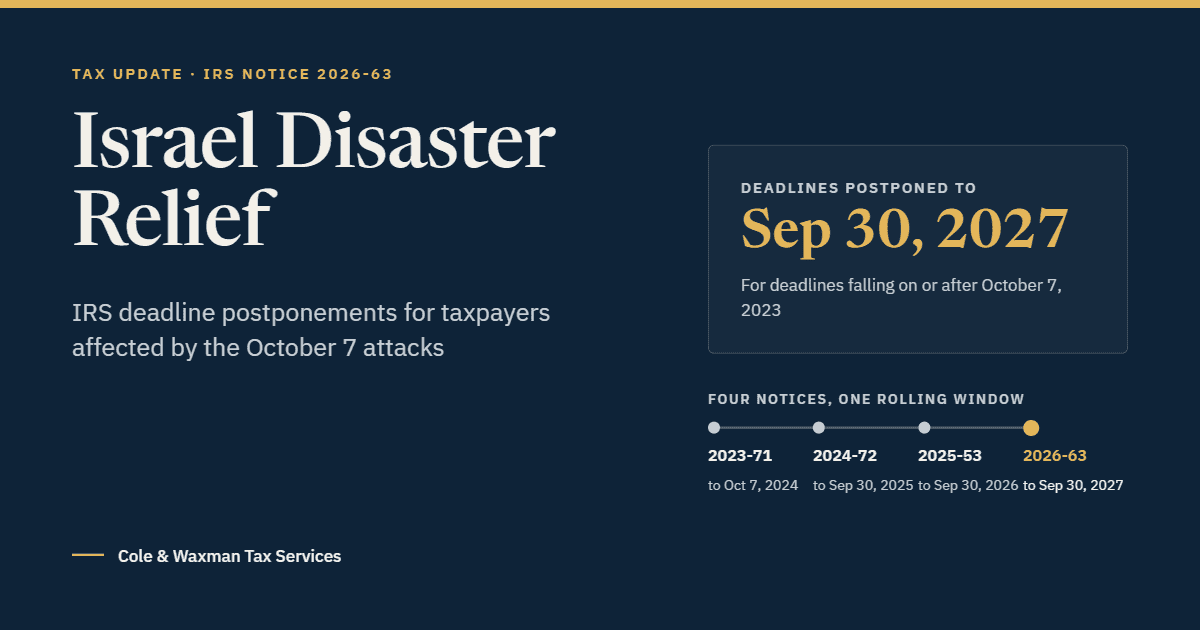
If you live in Israel, most US federal tax deadlines that fell on or after October 7, 2023 may be postponed to September 30, 2027. On September 30, 2026 the IRS issued Notice 2026-63, the fourth notice in a row granting this relief. Here is what the relief does, who qualifies, what it leaves out, and where the rules are still unclear.
Background
The relief rests on Internal Revenue Code §7508A, which lets Treasury postpone tax deadlines by up to one year for taxpayers affected by a federally declared disaster or by a "terroristic or military action" under §692(c)(2). Before issuing relief for an event abroad, Treasury confirms with the State and Justice Departments that the activity was directed against the United States or an ally (Rev. Proc. 2004-26).
Because each grant is capped at one year, the IRS cannot simply extend the original notice. Instead, every September it makes a new terroristic-action determination for the prior two years and issues a fresh notice. Each new notice starts its window on the day the previous one ends, so postponed deadlines roll forward without a gap for anyone who stays eligible.
Summary of the notices
Taken together, the four notices postpone deadlines falling between October 7, 2023 and September 30, 2027.
| Notice | Issued | Covers acts due | Postponed to |
|---|---|---|---|
| 2026-63 | Sep 30, 2026 | Sep 30, 2026 – Sep 29, 2027 | Sep 30, 2027 |
| 2025-53 | Sep 30, 2025 | Sep 30, 2025 – Sep 29, 2026 | Sep 30, 2026 |
| 2024-72 | Oct 1, 2024 | Sep 30, 2024 – Sep 29, 2025 | Sep 30, 2025 |
| 2023-71 | Oct 13, 2023 | Oct 7, 2023 – Oct 6, 2024 | Oct 7, 2024 |
Each later notice also carries forward anything still postponed under the earlier ones, but only for taxpayers who are eligible under both. For example, Notice 2026-63 states that a taxpayer eligible under 2025-53 but not under 2026-63 had until September 30, 2026.
Who is covered
You qualify if you fall into any of these groups listed in Notice 2026-63 (the earlier notices use the same list). The "covered area" is Israel, the West Bank and Gaza.
- Residents and local businesses. Any individual whose principal residence, or any business or sole proprietor whose principal place of business, is in the covered area.
- Taxpayers whose preparer or records are in Israel. Any individual, business, estate or trust whose tax return preparer, or whose records needed to meet the deadline, are in the covered area. This can include a US resident who uses an Israeli tax firm.
- Relief workers affiliated with a recognized government or philanthropic organization and assisting in the covered area.
- Spouses of an affected taxpayer, for purposes of a joint return only.
- Visitors to the covered area who were killed, injured or taken hostage.
If the IRS already has an Israeli address on file for you, relief is applied automatically. Everyone else, including US residents relying on an Israeli preparer, should call the IRS disaster hotline at (866) 562-5227, or (267) 941-1000 from outside the US, to request relief.
What is covered
The relief postpones three things: filing, paying, and the penalties and interest that would normally follow a late filing or payment.
- Filing. Income, estate, gift, employment and most excise tax returns due in the window. Under Notice 2026-63 that includes 2025 individual returns on extension (normally October 15, 2026) and 2026 returns (normally April 15, 2027).
- Payments. Balances due with those returns and estimated tax installments, including the January 15, April 15, June 15 and September 15, 2027 estimates.
- Penalties and interest. Under §7508A(a), the postponement period is disregarded when calculating interest, penalties and additions to tax. If you receive a late-filing or late-payment penalty notice for this period, call the number on the notice to have it abated.
- Other time-sensitive acts. Filing a Tax Court petition, filing a claim for refund, bringing a refund suit, and making qualified retirement plan contributions (see Treas. Reg. §301.7508A-1(c)(1) and Rev. Proc. 2018-58).
The IRS gets the same extra time on its side. Deadlines for assessing tax, issuing notices and demands, and collecting are also postponed for affected taxpayers.
A postponement is not the same as an extension. Notice 2026-63 says that if you need more time beyond September 30, 2027, you should check the extension rules for your specific return.
What is not covered
Anything due before October 7, 2023. The relief only reaches deadlines that fell on or after October 7, 2023. The IRS made this explicit in 2023: a 2022 return on extension (due October 16, 2023) could be filed late under the relief, but the 2022 tax itself was due April 18, 2023, so late payment of that tax was not covered. Interest and penalties on older balances continue to run as usual.
State taxes. The notices are federal only. Each state decides for itself whether to follow IRS disaster relief, so former US residents who still have a state filing obligation should check that state's rules separately.
FBARs, unless FinCEN says so. The FBAR is a Treasury (FinCEN) filing, not an IRS tax return, so §7508A does not cover it. FinCEN has issued parallel relief in the past, for example FIN-2024-NTC5 gave until September 30, 2025 for 2023 FBARs, but each year's FBAR relief should be confirmed directly with FinCEN.
Grey areas
Two questions come up often in our practice where the notices do not give a clear answer. Treat what follows as open issues, not settled law.
Statute of limitations on refunds
Filing a refund claim is a listed postponed act, and §7508A(a)(3) lets the postponement period be disregarded in determining the amount of a credit or refund. So a refund claim whose three-year deadline under §6511 fell in the window should still be timely if filed by September 30, 2027.
The harder question is the amount. Section 6511(b) limits a refund to tax paid within a "lookback" period before the claim, and withholding and estimated payments are treated as paid on the original due date. It is not settled how far four stacked notices, each a separate one-year grant, stretch that lookback. Taxpayers with old unfiled refund years should not wait until the last day, and should file as early as possible to reduce the risk.
Issuance dates of SSNs
Several credits require a Social Security number issued by the due date of the return. For example, §24(h)(7) requires this for a child to qualify for the child tax credit. Many families in Israel obtain SSNs for their children late, and file returns during the postponement period.
The open question is whether "due date" means the original statutory date or the postponed date. Notice 2026-63 itself says a postponement is not an extension of time to file, which cuts against reading the postponed date as the due date. We are not aware of published IRS guidance resolving this.
A case from our practice. One of our clients lives in Israel and had a child born in 2022. The child's SSN was issued in November 2023, after the extended due date for 2022 returns (October 16, 2023). She claimed the child and the child tax credit on an amended 2022 return. The IRS rejected the claim, citing the SSN timing rule. We appealed, arguing that the disaster-relief postponement moved the 2022 due date, so the SSN was issued in time. Appeals agreed and allowed the credit.
The outcome was favorable, but it took years. The amended return was filed in April 2024, rejected in March 2025, and resolved only after a reconsideration request and a formal Appeals protest. One Appeals result is also not precedent, and another taxpayer could get a different answer. Families should still apply for SSNs as early as possible rather than rely on the postponement.
What this means for you
Unless the IRS issues a fifth notice, everything postponed since October 7, 2023 must be filed and paid by September 30, 2027. That includes 2023, 2024, 2025 and 2026 returns that have not yet been filed.
- Don't let three years of returns pile up into one deadline. Filing early costs nothing and avoids a crunch.
- If you moved out of Israel, check whether you are still eligible under the latest notice. Relief only carries forward for taxpayers eligible under each notice in the chain.
- If you live in the US (or anywhere outside of Israel) but your preparer or records are in Israel, call the IRS hotline to have relief applied to your account. IRS disaster hotline is (866) 562-5227, open 8AM central time.
- If you are owed a refund for an older year, or need an SSN for a child, act now rather than rely on the postponement.
Cole & Waxman Tax Services works with US taxpayers in Israel on returns, FBARs and IRS correspondence. If you are unsure how the relief applies to you, contact us.
Sources
- IRS Notice 2026-63 and IR-2026-116
- IRS Notice 2025-53
- IRS Notice 2024-72 and IR-2024-252
- Notice 2023-71, summarized by KPMG and The Tax Adviser
- FinCEN FIN-2024-NTC5
Disclaimer
This article is provided for general educational and informational purposes only and does not constitute tax, legal, investment, or financial advice. Reading this article or communicating with Cole & Waxman Tax Services does not create a client relationship.